Experience Debt: The Hidden Cost of a Promise Your Brand Can't Keep
Marketing owns the expectations, not the experience, so when delivery falls short, customers blame the brand. This "experience debt" caps retention, and AI worsens it by raising expectations a broken journey can't meet. The fix isn't more spend, but repairing the experience.
Think about the last time a hotel loyalty program made you feel like a valued guest.
The welcome email you received was certainly warm. The points you’ve earned through years of travel was prominently displayed. The app reminded you how close you were to your next status tier. The marketing was highly personalized – they knew your name, your preferences, your anniversary. It felt personal. It felt like a relationship.
Right up until you tried to redeem your points.
Suddenly the dates you wanted weren't available on points. Cash only! The room category you earned wasn't bookable through the app, only by calling. The number put you on hold. The agent couldn't see the promotion you were responding to. You were transferred. You re-explained everything. The points you'd accumulated over three years of travel bought you a Tuesday night in a city you didn't want to visit.
The marketing was flawless. The experience was its exact opposite.
That gap - between the promise marketing makes and the experience the organization delivers - has a name.
It's experience debt. And if you're a marketing leader, it’s actively working against everything you build.
What Experience Debt Is
"Experience debt is what happens when years of reasonable decisions accumulate into an unreasonable experience."
The hotel loyalty program certainly wasn't designed to frustrate its best customers. Quite the contrary! It accumulated that way. A points system built on one platform. A booking engine on another. A call center running a third. An app developed later that couldn't fully integrate with any of it. Promotional logic managed in spreadsheets. Inventory rules set by revenue management that marketing couldn't see.
Every decision was defensible. None of them were made with malicious intent. Together, they produced an experience that systematically contradicts the brand.
Nobody is the villain in this story. But somebody is paying the price - and that somebody is your most loyal customer.
Why This Is Fundamentally a Marketing Problem
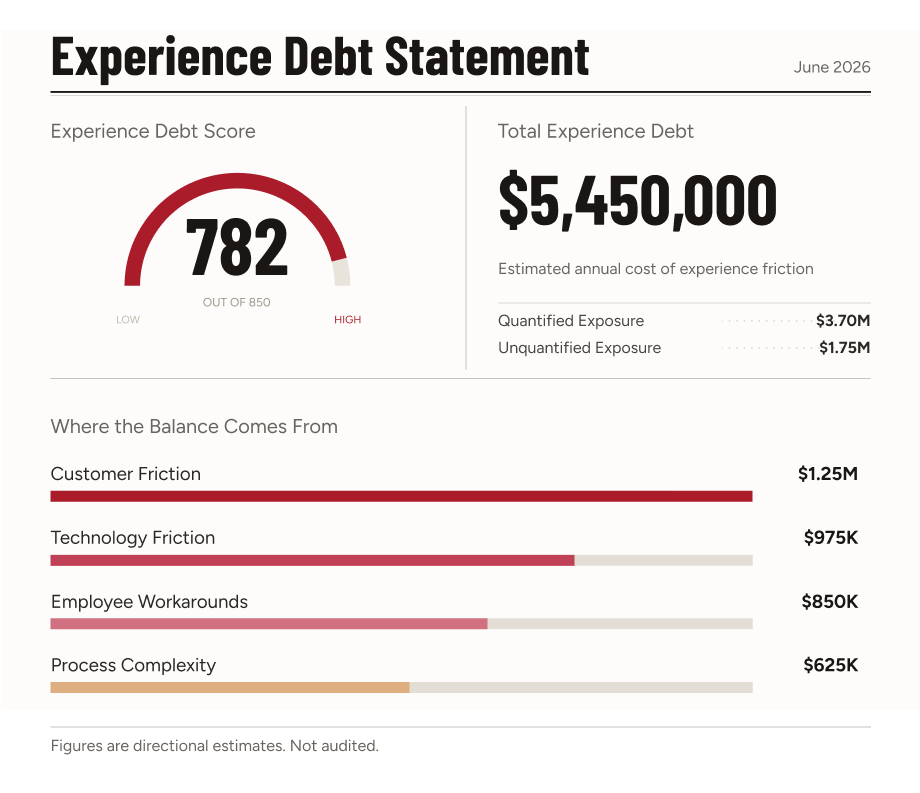 For most organizations, marketing doesn't “own” the experience. But marketing owns the expectation (and gets the shade when it falls short).
Every campaign you run, every message you send, every brand promise you make - each one sets a bar. And when the experience falls short of that bar, the customer doesn't blame the process or the technology or the org chart. They blame the brand. Which means they blame you.
This is why experience debt is particularly corrosive for marketing organizations. You can optimize acquisition endlessly, but if the experience erodes trust after the first interaction, you're effectively filling a leaking bucket. Every dollar spent on growth has to work harder to compensate for the loyalty you're failing to build.
Research suggests companies lose between 20 and 30 percent of annual revenue to process inefficiency and friction. For a marketing leader, that number has a name: it's the ceiling on your retention rate, your lifetime value, and ultimately your ability to justify the acquisition spend.
What AI Makes Worse
Personalization at scale is only as good as the experience it lands in.
A hyper-personalized message that drives a customer into a broken journey doesn't just fail - it fails with supreme gusto. It raised the expectation and then immediately tripped over itself. That's worse than a generic message delivered into the same broken journey, because now the customer knows you had the data and still couldn't deliver.
The hotel loyalty program already knew everything about you. It knew your room preferences, your travel patterns, your dietary restrictions. The marketing felt personal because it was. What it couldn't do was deliver on that personalization at the moment that mattered most - when you wanted to use what you'd earned.
Organizations rushing AI investment into marketing without first addressing accumulated experience debt are accelerating a trust problem, not solving one. The brands that will win with AI-driven personalization are the ones whose experience can actually fulfill the promise that personalization makes.
Shop Your Own Brand
If you became your own customer tomorrow - going through your actual purchase, onboarding, or loyalty experience - what would you encounter?
- Would the experience reflect the brand you're marketing?
- Where would the promise break down?
- What would you stop trying to do?
- And what have you simply stopped noticing because you've been inside it too long?
Common Symptoms of Experience Debt in Marketing
How many of these are true in your organization?
- Acquisition metrics are strong but retention is flat or declining.
- NPS or CSAT scores haven't meaningfully improved despite technology investment.
- Customers respond to campaigns but don't become loyal.
- Personalization initiatives underperform because data is fragmented across systems.
- Support volumes remain high for issues that should have been designed away.
- Your brand promise and your customer feedback don't tell the same story.
- Cart or journey abandonment persists despite UX and campaign optimization.
If several of these are familiar, you may not have a campaign problem or a channel problem. You may have an experience debt problem — and no amount of marketing spend will resolve it.
Experience Debt Discovery Session
A facilitated working session designed for marketing and CX leaders who suspect the experience is working against them - and want the evidence to do something about it.
In a single session, we work with your team to map where friction concentrates across the customer journey, identify the gap between brand promise and delivered experience, and establish a prioritized starting point for remediation.
You leave with a clear picture of where experience debt is highest, how it's affecting acquisition and retention economics, and - critically - the language to make the case internally for addressing it.
"Most marketing leaders already know something is wrong. The Discovery Session is designed to show you exactly where — and give you the framework to fix it."
Your Facilitator

Mark Emery
Practice Director, Customer Experience — Synoptek
Mark Emery has spent more than twenty years working at the place where brand promise meets organizational reality, helping companies understand why the experience they deliver doesn't always match the one they intended.
His background spans both sides of the table. He's led content and social strategy for IHG's global portfolio of more than 5,000 hotels, managed brand and digital programs for clients including Southern Company, Coca-Cola and HBO, and built advocacy and community marketing programs for consumer brands. He understands what it takes to build a compelling brand promise, and what it costs when the experience undermines it.
At Synoptek, Mark leads the CX Strategy and Digital Transformation practice, working with enterprise organizations to identify where accumulated friction is suppressing the return on their technology and marketing investments. He developed the Experience Debt framework because the pattern kept repeating: strong brands, smart campaigns, and experiences that undermined both.
He's also spent time on the other side of the stage - as a board member of Dad's Garage Theatre in Atlanta, one of the country's leading improvisational theater companies, and as a drummer in a rock band. It turns out building an experience that earns an audience's trust, night after night, teaches you a great deal about what breaks it.